


Our Work
Advocacy & Research
Policy-level interventions for systemic change
About the Programme
Action research and advocacy initiatives form an important part of AMAN Trust's work in the field of social and welfare development. Policy-level interventions for systemic change.
Ground-level relief and service delivery must be complemented by systemic advocacy to address the root causes of marginalisation and violence. Aman conducts original research, builds networks of civil society actors, and engages with policy makers to push for structural reforms that protect the most vulnerable.
Field Projects
Documented advocacy and research initiatives implemented by AMAN across India.
Capacity Building & Advocacy for Scrap Worker's Rights and Health, Delhi
Project Period: 1st June 2015 to 31st May 2016
A large population of immigrants, refugees and migrants in the city of Delhi is part of the labour force in the unorganized sector. Not much has been done to address the challenges faced by these workers across Delhi.
With a vision to address the challenges faced by migrant workers, AMAN Trust, with the help of its donor agency American Jewish World Service (AJWS), conducted various capacity building training and awareness generation activities under this project. The highlights of advocacy-related activities were:
1. Mobilizing the rag pickers and urban waste worker community in the Okhla and Jahangirpuri localities of south and north Delhi through capacity building workshops and community meetings.
2. A one-day workshop on climate change and urban waste management held on 9th August 2016 in Jahangirpuri G Block, attended by 21 workers from both north and south Delhi regions.
3. An exposure visit to the Dry Waste Collection Centre (DWCC), Jayanagar, Bangalore, to understand and document the process of dry waste collection and build the capacities of scrap workers.
4. Case studies and documentation of migrant rag-picking and urban waste processing workers, aiding their living conditions by connecting their cases to local CSOs and human rights advocates.
Considering the success of its first phase, the project has been extended further to reach a greater number of scrap workers across Delhi.
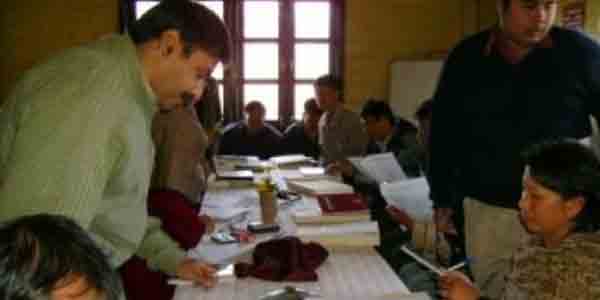
Report on Governance Review of Northeast by Working Group on Northeast Action Research
Since independence, governance in India has constituted an interplay between traditional and state structures. The situation in the Northeast is particularly complex, with over 200 ethnic groups with their own languages and socio-cultural identity, and wide-ranging governance structures — the Sixth Schedule Frame (entire Meghalaya, parts of Assam, Mizoram and Tripura), State Legislation Frame (VDCs in Nagaland and Mizoram), and the National Frame in the form of Part IX (panchayats) and Part IX A (municipalities) in Arunachal, Sikkim, the plains of Manipur and non-council regions of Assam and Tripura. Yet the hill areas of Manipur have been excluded from the purview of any of these frames without provision for an alternative, creating a vacuum in the legal frame for that area — posing a particular challenge for inclusive governance and development. In addition there are Special Constitutional Provisions such as Articles 371 A, 371 B, 371 C, 371 F, 371 G, and 371 H.
This arrangement of local governance, and the varying capacity of different groups to participate, has resulted in uneven development among tribes and social groups within the overall underdevelopment of the Northeast. Under these circumstances, political mobilization for autonomy and the politics of ethnic identity have become salient features of the region over the last couple of decades.
The working group was formed at AMAN Trust with support from the National Foundation for India, with a vision to gain more clarity on the subject. The study began in May 2015 and attempted to map the dynamics of governance and the hypothesis of uneven development. 70 percent of the research was based on secondary data sources, while the balance of work was carried out through the involvement of experts, local communities, scholars, government officials and other stakeholders from both the centre and the Northeastern states. The project concluded in January 2016 with a consolidated draft report submitted to members of the Northeast Action Research working group by the appointed Research Consultant, in New Delhi and Guwahati.
Aman Kanooni Sahayata Kendra
AMAN also runs a Legal Aid Cell called Kanooni Sahayta Kendra (KSK) in Jehanabad town. The centre provides legal assistance to vulnerable and marginalized people caught up in legal conflicts who cannot afford expensive, and sometimes exploitative, legal services. Several hundred such cases have been handled by the Kendra. The majority of clients are victims of caste-related or domestic violence. Presently the Kendra is fighting cases for NREGA workers for the payment of their dues from the government.
Under the Indian Constitution, after independence, law and the judicial system were entrusted with the task of adjudicating disputes and determining rights — a progressive measure to prevent individuals and groups from settling grievances through personal acts, invariably violent, that could lead to generations of vengeful conflict.
However, for the legal system to achieve the desired result, accessibility of law was a precondition. Increasingly, marginalized, weak and oppressed segments of society found themselves unable to access the legal machinery due to economic and social disadvantages. This was addressed by the judiciary in the 1980s through Public Interest Litigation and the creation of a national-level statutory legal aid service. However, for a range of reasons, that scheme was unable to achieve its full potential and became ineffective — no longer providing a real option for the marginalised to access the law. It was in this context that the KSK was established.
The KSK is located at Fida Hussain Road, Jehanabad, Bihar, and functions as a unit of AMAN Trust. It provides legal aid to certain specific categories of persons and is not a general legal aid centre as envisaged by the Legal Services Authority Act — in keeping with the objective and vision of AMAN.
Jehanabad has a long history of caste and class massacres, and once AMAN was able to identify a group of lawyers willing to provide legal services, the KSK was established there.
Aim: it is understood that if the weak and oppressed are systematically and continually deprived of their rights and subjected to atrocities, endless spirals of violence are bound to follow. The KSK aims to provide vulnerable and weaker sections of society with access to law, enabling them to realise their rights, redress wrongs, and resolve disputes through the legal system rather than through recourse to violence.
Output 1 — Legal Aid / Litigation: the KSK offers free legal support to poor, oppressed and vulnerable sections of society on a range of issues, including women's rights, Dalit (SC/ST/OBC) rights, workers' rights (such as wage claims), police atrocities, consumer protection (life and health related), and motor accident claims — and other instances where a case of injustice against the poor or oppressed is made out. An informatory flyer with relevant contact details, in Hindi and English, is available for distribution.
Sometimes, due to a range of circumstances, disputes are settled out of court and cases are not pursued further by the complainant. While such cases may stand disposed of on court records, given the cyclical nature of domestic violence, the complainant may remain vulnerable to future violence. Keeping this in mind, the KSK is committed to monitoring such cases through follow-up visits — at least two every three months — after an out-of-court settlement, to ensure the client's safety and wellbeing.
Output 2 — Legal Awareness / Workshops, including capacity-building of members through regularly organised training workshops for KSK members.
The KSK operates out of AMAN's office on Fida Hussain Road, Jehanabad. It is led by Adv. Deorani, who takes regular assistance from other lawyers in the district.
Community Mobilisation on Social Security Programmes
AMAN started working on community participation in the implementation of government-run poverty alleviation and social security programmes in two villages several years ago. The work has since expanded to over 30 villages across four blocks of Jehanabad and Arwal districts. Recent years have seen a series of activities at different levels, with people taking charge of the implementation of programmes including MNREGA, Indira Awas Yojana, ICDS, and pension schemes. Village-level committees now take responsibility for ensuring that PDS shops function properly and that benefits reach the weakest members of the community.
Transforming for Empowerment
An independent theatre group named Lok Panch has been formed in Patna, bringing together senior theatre activists under a collective leadership — two of whom are AMAN workers. The group uses Theatre of the Oppressed to transform theatre practice from being didactic to participative. It has prepared a play on the theme of declining sex ratio in India, performed at five locations where the most oppressed communities live — three in different slums of Patna and two in the Musahar bastis of Paliganj block, Patna district. All costs involved in preparing and performing the play, and travel, were arranged by the group itself. More than a thousand women and men participated in forum discussions during the performances.
Legal Assistance to Asylum Seekers (as directed by the UNHCR), India
Project Period: January 2017 - Ongoing
AMAN Trust supports ARA Trust in providing legal aid and due representation to asylum seekers and the refugee population from Afghanistan, as listed under UNHCR guidelines. ARA Trust, being the only organisation with a Letter of Understanding with UNHCR India, addresses the vulnerabilities of asylum seekers in India who have fled warfare.
Marginalization and exclusion from the justice system renders the refugee population vulnerable. This project aims to bridge the gap between refugee policies and laws in India through intervention that helps the refugee population access legal, medical, redressal and recovery-related services. Activities include meeting policy makers, publishing newspaper articles on the issue of asylum seekers, holding community meetings to share information, encouraging and supporting activist groups, film screenings, podcasts, radio shows, and awareness generation on social media channels. Empowering the women refugee population through activities focused on their assimilation is also part of the project's mission. The project has successfully provided trauma, medical and legal counselling by working directly with refugees, in collaboration with UNHCR India staff.
Update on Queer Writing Series
Project Period: July 2015 - May 2018
Queer and feminist politics are at a peculiar crossroads in India today. Earlier histories of the queer movement in India were rooted, in many ways, in an intersectional, feminist politics that saw gender, sexuality, caste, race, religion and ability as intrinsically connected. Such a politics had the opportunity and potential to build a sexuality politics that was more than just LGBT, including all those denied sexual rights — a broad list in India. The Supreme Court reversal of the 2009 judgment returned a sense of uncertainty to queer spaces; reactions have had many facets — while opinions are changing, a climate of intolerance has been emboldened and the law has again been used as a tool of discrimination.
This project marked a significant step forward by opening up the production of knowledge — publishing texts on gender and sexuality that are freed of copyright, translated into regional languages, and circulated free of cost after a period of time. It created a sustainable, accessible and rigorous portfolio of writing and publication on the key themes of gender, sexuality and rights, comprising 4-6 titles within these broad themes.
Gender-Sensitive Citizenship: An Ebong Alap AMAN Trust Initiative
Project Period: May-June 2016 to May-June 2017
AMAN Trust, in collaboration with Ebong Alap, Kolkata, executed a project on creating Gender Sensitive Citizenship in the regions of West Bengal, supported by the Human Capability Foundation (HCF). For the past five years, AMAN and Ebong Alap have jointly executed various projects concerning gender justice, peace building, and mobilising youth in educational institutions on social welfare and human rights issues. In continuation of this collaboration, AMAN and Ebong Alap held a series of discussions and workshops aimed at advocating gender sensitivity in educational institutions across West Bengal, working with grassroots community-based organisation Disha in the Sunderban region.
In partnership with fellow NGOs, the project bridged the gap between the women of Sunderban island, the urban middle class, the rural working class and youth through a range of activities. The project team, in collaboration with the state government's Sarva Shiksha Abhiyan, worked with adolescents to generate awareness on gender and sexuality issues in seven government high schools across the highly sensitive Indo-Bangladesh border region. The main issues addressed were: (i) relationships, friendships and issues of sexual abuse, and (ii) cell phone use and misuse. In collaboration with Sappho for Equality, two workshops were conducted on self, society and gender-sexuality, discussing queer issues with trans, bisexual and intersex participants in the Sunderban region.
The project succeeded in initiating dialogue among adolescents on issues pertaining to gender sensitivity. Responses recorded from children showed that the workshops helped build understanding on sexual abuse and adolescent girls' health and hygiene, and the need for gender sensitivity. The project also succeeded in securing collaboration with the West Bengal state government, resulting in enhanced intervention.
Research Areas
Aman's research informs both its own programmes and the broader civil society ecosystem working on peace and justice in India.
- Communal violence documentation
- Legal aid and access to justice
- Governance review and conflict prevention
- Policy advocacy for marginalized communities
Publications & Reports
Aman's research outputs — including reports, essays, and documentation — are available in our resource library for researchers, practitioners, and advocates.
Browse ResourcesCollaborate on Research
We welcome collaboration with academic institutions, civil society organisations, and policy researchers working on related themes.
Get in Touch